
Agatha Christie & Redbook (1933-1967)

What do Agatha Christie, Shirley Jackson, Dashiell Hammett and James Cain all have in common? Many of their novels first appeared in Redbook, a magazine with a rich literary heritage that sadly exists no more.
Literary Magazines.
Agatha Christie’s novels were frequently serialised in magazines and newspapers before their initial hardback edition was published. These publications are appealing to collect as many are true first printings and many were accompanied by original illustrations. A variety of publications secured the rights to Christie’s stories, including well-known historic titles such as The Sketch and The Strand, and newer titles such as Woman’s Own.
Redbook.
One magazine that published four Agatha Christie stories in magazine form, and also one in book form, is Redbook - an American women's interest magazine that was published by the Hearst Corporation. The magazine was first published in May 1903 as The Red Book by Stumer, Rosenthal and Eckstein, a firm of Chicago retail merchants. The name was changed to The Red Book Magazine shortly thereafter.
In 1927, Edwin Balmer, a short-story writer who had written for the magazine, took over as editor; in the summer of 1929 the magazine was bought by McCall Corporation, which changed the name to Redbook but kept Balmer on as editor. During its early decades, it was primarily a literary magazine and frequently published stories from well-known authors. For example, in the 1930s F. Scott Fitzgerald was frequently published and Dashiell Hammett’s The Thin Man appeared in December 1933, one month prior to its book publication. In the 1940s and 1950s, authors such as James Cain and Shirley Jackson graced their pages.
Christie in Redbook.
Agatha Christie first appeared in Redbook in 1933 and her last appearance was in 1967. In addition, Redbook published one hardback anthologies of novels that appeared in their magazines. Christie’s novel, The Boomerang Clue (UK title: Why Didn’t They Ask Evans?) was included in this December 1933 book publication titled Six Redbook Novels. To learn more about that true first edition book version, see this link.
By the 1980s, the magazine had shifted away from literature and towards lifestyle and fashion. The publication mostly ceased operations in 2019.
The Christie Redbook stories in chronological order.
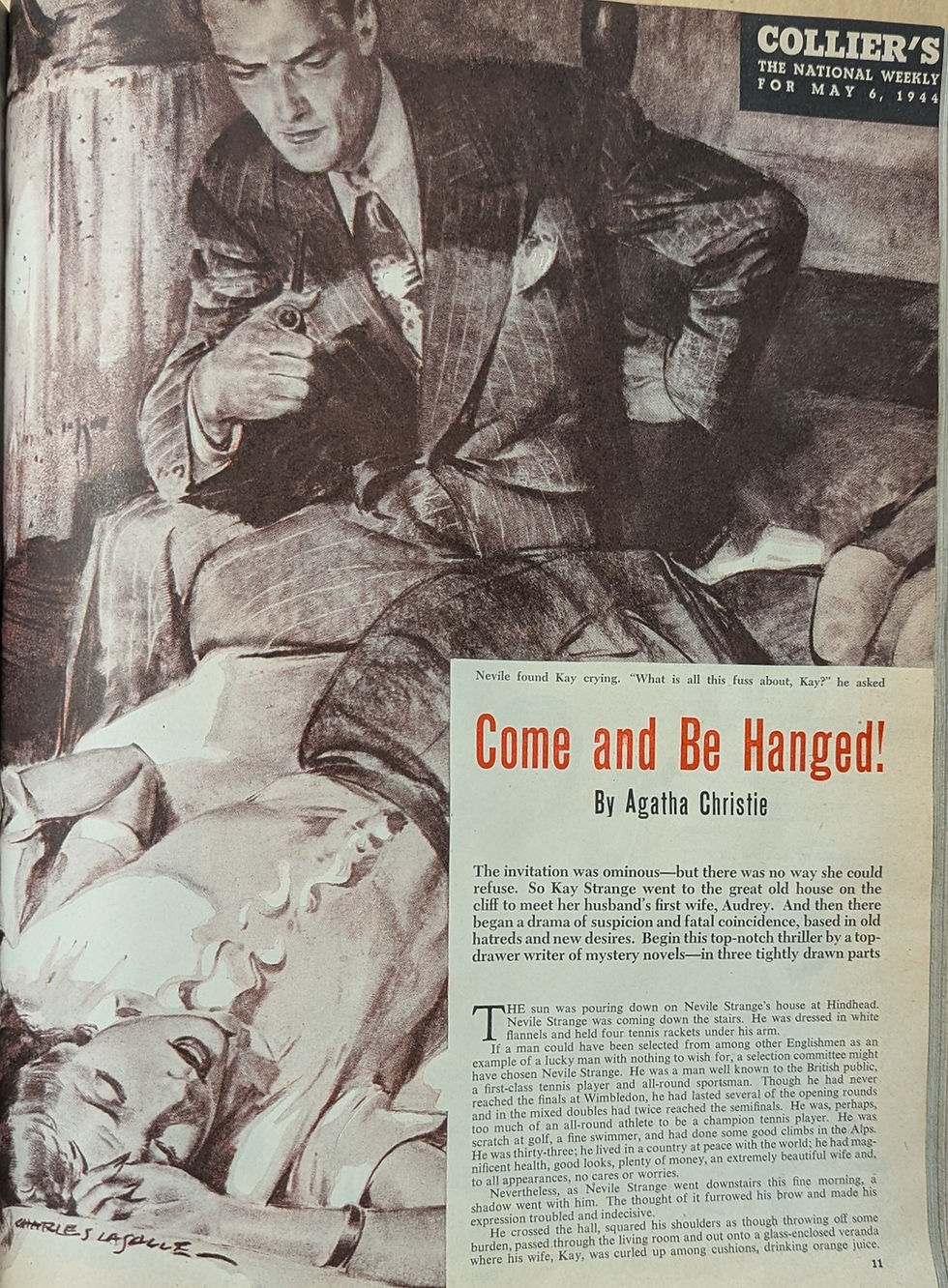
For each of the publications, all artwork is reproduced below with the exception of The Boomerany Clue. To see all the artwork for that publication use the link above. It is interesting to note how the style and volume of art changed over the decades, and even the medium.
1933: The Boomerang Clue. Vol. 62, No. 1 (November). UK title: Why Didn’t They Ask Evans?
Abridged slightly and substantially illustrated by Joseph Franké. In Britain, this novel was serialised in the London News-Chronicle from September 19, 1933 through November 1, 1933. So while parts of the novel first appeared in the UK, the last instalment occurred on the same date as the publication of this magazine in the States – thus this is a tied-first global appearance of this novel. As mentioned earlier, the novel first appeared in book form in December 1933 as part of Redbooks’ Six Redbook Novels anthology. The first unabridged appearance was published by Collins in September 1934 and in the US a year later.
1936: Murder in the Mews. In two instalments. Vol. 67 No. 5 (September) & 6 (October).


Richly illustrated by John Fulton. This is the first global appearance of this novella. Its first British appearance was in Woman’s Journal two months later, in December 1936, under the alternate title Mystery of the Dressing Case. It first appeared in a book collection in March 1937 when it was included in Murder in the Mews: 4 Poirot Stories, published by Collins’ The Crime Club imprint. In the US, this collection appeared three months later under the collective title Dead Man’s Mirror.
1941: N or M? Vol. 76 No. 5 (March).


Abridged slightly. Illustrations by Alan Haemer. This is the first global appearance of this novel. In the UK, Woman’s Pictorial serialised it across seven instalments from April through June 1941. The novel first appeared in book form in the States where it was published by Dodd, Mead & Co. in June 1941. In Britain, Collins published it in November 1941.
1967: Third Girl. Vol. 128, No. 6 (April).
Abridged slightly and under the slightly incorrect title of 'The' Third Girl - as occurred later with Fontana. Accompanied by a single photographic montage by Mike Cuesta. This is the first American appearance of this novel as it had already been published in the UK by Collins in November 1966. It did not appear in book form in the US until September 1967. This almost one year spread between the British and American publications is likely due to the publications of 13 Clues for Miss Marple, a collection that only appeared in the US and was published in August 1966, and At Bertram’s Hotel that was published in September 1966. Issuing another Christie in the States in rapid succession was likely seen as too risky for dilution of sales – hence the delay in Third Girl until the following year.
Values and Collecting Tips.
While many Redbook magazines appear for sale across online platforms, those containing Christie stories are less prevalent so patience is required. When they appear for sale, expect to pay $20-30 for a ‘very good’ copy.
When collecting magazines, if the story appeared over several instalments there is frequently more value to be achieved by sourcing copies that are not marketed as a complete Agatha Christie set. Buying individual issues or random sets and building your own complete set per title will likely be the most affordable way to collect them. It is also quite good fun to have a checklist of all the issues of different magazines you want and solely buy them as individuals until one days sets are completed – a bit like ‘Happy Families’! Knowing the specific issues you want is important as many vendors of magazines solely show the covers and fall to be specific about the contents. In addition, many magazines did not always reference Christie’s name on the cover, especially with instalments beyond the first appearance. This is why I’ve included images of all the covers for each title’s issues.
As to condition, expect most American magazines from the mid-20th century to have address labels affixed. Damage to the spine, separation of covers, dirt and wear are all common. While not something I typically write about, all of these issues can generally be improved or stablised with the right materials and skill. If magazine repair appeals to you, consider viewing related videos on YouTube or reading books about conservation. In addition, I do recommend storing magazines in acid-free clear sleeves to avoid further damage.
Other News.
I will be presenting at the 2026 International Agatha Christie Festival on 'Roger Ackroyd Day' - September 17th 2026 - in Torquay, Devon, England. My talk celebrates the centenary of this ground-breaking mystery novel voted the best crime novel of all time by the Crime Writers' Assocation. My illustrated talk will bring fresh insights into the story's life - from print to stage to screen. Individual tickets are still available. Full details & tickets at this link.
Corrections, Edits, Recommendations.
I always value reader input to make my articles more accurate. So if there are any additions or corrections you'd like to provide, please email me at collectchristie@gmail.com
Subscribe & the Socials.
If you are not a subscriber to my website, please consider subscribing here: link. This ensures you receive an email any time I write and post an article. Re: Social Media accounts - do consider following me on X @collectchristie , on BlueSky @collectchristie.bsky.social and on Facebook. The content on X and BlueSky is usually identical, but will vary on Facebook. I am also now on Instagram. All should be of interest for any fan of Agatha Christie.


Two minor points... I see they used the title THE Third Girl, so Fontana wasn't the only guilty party there.
Secondly... did John Fulton portray Poirot with a GRAY mustache?! Oh, my. Unforgiveable. 😆