
Agatha Christie's 1920s Films: Collecting & Watching

Updated: Aug 22
For fans of Agatha Christie, watching film adaptations of her works is an activity enjoyed by most. Many fans also choose to build a personal library of her film and television adaptations. Some collectors also pursue film-related ephemera – from posters and lobby cards to soundtracks and other memorabilia. Several of the earliest film and television adaptions present challenges for fans and collectors alike as they are either lost or hard to watch, and related memorabilia is fairly scarce.
A New Edition of the 1929 Film Adaptation of The Secret Adversary.
A project I just completed improves the accessibility and viewing experience of the earliest surviving film adaptation of a Christie novel, opening it up to a much larger audience to enjoy. For lack of a better term, I’m referring to this as a 'Collector’s Edition' of the 1929 silent film ‘The Secret Adversary’. While challenging to find, the film had been available in a few places but it was hard to enjoy and likely only ever reached a very niche audience. One version floating around online has only Dutch and French intertitle cards (the inserted text cards in silent films that provide the story and dialogue) and a very unpleasant jarring audio track. Another version has a mildly better audio track (though with no consideration of the visuals it supports) but was still without English intertitles.
Vintage silent films with deteriorating film stock are challenging enough to watch without these extra hurdles so I set about to create a new version that would make this film fun entertainment – just as it was meant to be almost a hundred years ago. My version features English language intertitle cards, a varied & dynamic classical musical soundtrack that aligns with the onscreen action, a new opening sequence that builds excitement, plus a bonus feature at the end that examines the film’s history. Adding to its shelf appeal, the DVD case is wrapped in the original promotional material.

I hope you will consider buying one or more to enjoy for yourself and your fellow Christie fans. The proceeds will help offset the costs incurred to create it, but also the ongoing operating expenses related to the CollectingChristie.com website. More details, including how to order a copy, are at the bottom of this article. Now back to the 1920s films!
A Brief History of British Film in the 1920s.
Agatha Christie’s first novel, The Mysterious Affair at Styles, was first published in Britain in January 1921. Across the 1920s she had a total of nine novels, two short story collections, and dozens of individual short stories published. So given this volume of work and her success, it is no surprise that the motion picture industry would look to determine if her stories could be converted to film.
In the late 1920s, one factor that likely improved the prospects for the adaptation of Christie to screen was the British government’s intervention to grow the domestic film industry. Because Britain struggled to match Hollywood's larger budgets and stars, the government enacted the Cinematograph Films Act of 1927. Beginning in 1928, among other measures, this act required that at least 7.5% of films shown at British cinemas to be made in Britain. This quota increased over time, reaching 20% by 1935. One studio that decided to create British films to take advantage of this demand did choose to adapt an Agatha Christie story to film as part of their initial foray into this market.
THE 1920 FILMS.
1923: Anne, The Adventurous.
Status: The film was unmade and there is essentially no related ephemera. I've included this "film-that-doesn't-exist" in the list because of the confusion that periodically arises related to it.
The first hint of a Christie film occurred on November 29, 1923 when her novel, The Man in the Brown Suit, was first serialised in The Evening Standard, a London newspaper, under the title Anne, The Adventurous.

In that very first instalment there are two photographs that imply a film is being made of the book. On the first page of this instalment, a photo shows Anne Beddingfeld standing on a rock, overlooking Victoria Falls. The caption reads: ‘Anne, The Adventurous – A Paramount Picture’.
On the second page of the instalment, there is a picture of Anne in her cabin aboard the Kilmorden Castle, when Harry Rayburn bursts into the room. Under the image the caption reads: ‘With the suddenness of a bombshell my cabin door burst open and a man almost fell inside. “Save me,” he cried hoarsely. (A thrilling incident in a future instalment of Anne the Adventurous). A Paramount Picture.’
Needless to say, no such film was made. Film expert, Dr. Mark Aldridge, believes that images from another film were likely used solely to illustrate the story. It should be noted that a very thorough and complete resource for fans of Agatha Christie on film is his book Agatha Christie on Screen published by Palgrave MacMillan.
Another possible reason (and it’s purely speculative) that the film was not made is that a silent film adaptation of E. Phillip Oppenheim’s novel ‘Anna, the Adventuress’ had just been released two years earlier. Perhaps concern arose that similar titles could lead to confusion or that filmgoers may skip it thinking they had already seen the film. Another could have been copyright issues given this prior film’s similar name. Although records do show that in 1924, Agatha Christie was able to secure a copyright for the film title ‘Anne, the Adventurous’. So even with the copyright secured, no film was made and for collectors of Christie film related memorabilia these two newspaper images of the film that never was are the only items to seek.
1928: The Passing of Mr. Quinn.
Status: This silent film is lost, but related collectibles exist.

On May 3, 1928, an announcement appeared in Kinematograph Weekly stating that Argosy Film Co., Ltd. and Cecil Cattermoal, Ltd. signed an agreement on May 1, 1928, to produce Argosy’s first ‘quota’ film. It further states: A particularly strong story has been selected, based on a novel by Agatha Christie.
This film is based on Agatha Christie’s short story The Passing of Mr. Quinn, which had first been published in The Grand Magazine (UK) in March 1924. It is worth noting that the short story collection The Mysterious Mr. Quin was not published until 1930, so the decision to chose this story was not driven by its appearance in a book publication. When the story was included in the book collection, its title was changed to The Coming of Mr. Quin; however, this was after the film had been made.
We learn that Julius Hagen is the producer, Leslie Hiscott the director, and the cast includes the young Australian actress Trilby Clark. We are told production will being on Monday May 7, 1928. The casting of Stewart Rome, the other lead, was not announced until the following week.
Filming occurred completely at Twickenham Studios (formerly Alliance Studios), which was now controlled by Julius Hagen, and wrapped on May 26, 1928. Stills from the film were released during July across various trade magazines, and the first screening to the trade occurred on July 31, 1928 at The Hippodrome in London. It was billed as an ‘All British super production’. Trade shows were screened around the country throughout August.
A review of that first screening appeared in The Bioscope on August 1 that summarized the film review as follows: Highly sensational mystery of an eccentric professor’s death. Explanation by flashback. Gripping interest alternating with feebleness. The reviewer also stated ‘The film is a long one, and a little condensation in the early scenes would be advantageous.’
The following day in Kinematograph Weekly, a reviewer stated ‘The picture holds interest… The acting generally is good… [Theatres] should do really good business with it if the longer scenes are cut a little.’
The film was initially 90 minutes long (8,259 feet). Argosy Film Co. clearly reacted to the critics as they re-registered the film on August 9 with a revised length of 7,611 feet, which implies a new run time of 82 minutes.
Below are two stills from the film.
On January 14, 1929, the first public screening of the film occurred at the New Gallery Theatre in London, but as a second feature to the top billed ‘The Awakening’. It appeared to only receive three days of performances. It wasn’t until June 3, 1929, that The Passing of Mr. Quinn was released to the public and marketed with its own top billing.
Related Collectibles: For collectors of film memorabilia, there are several options to seek out. The magazines that are most appealing are those that contain stills from the film. These are the July 12, 1928 issue of Kinematograph Weekly and the July 25, 1928 issue of The Bioscope. In addition, the July issue of Argosy News contains extensive details about the production, its musical score and the fashion worn by Trilby Clark in the film.

Film posters, such as the one above, were also made available to theatres as part of a publicity kit. Each kit included two 6-sheet posters, one 12-sheet poster and one 48-sheet poster. In the late 1920s, a 6-sheet poster was approximately 40 x 80 inches while a 12-sheet was squarer at 80 x 80 inches. The 48-sheet was 120 x 240 inches (so 10 x 20 feet – essentially a billboard size). I doubt any 48-sheet posters still survive, and even the 6 and 12 sheet posters are exceptionally scarce with only a few known, mostly in museum collections. Should one appear for sale, it is hard to predict the price but I expect it would easily command many thousands of pounds.
The Film Tie-In Book: A tie-in book was originally printed by The London Book Company, London, UK in April 1929. For collectors, this is the second rarest tie-in book to find ('Alibi' is harder to source).
Several years ago, a few ‘very good’ jacketed copies sold in the £400-500 range. Prices certainly are higher today and one is currently for sale at over £2,500 by a reputable dealer, though it remains unsold. The original jacket has unique cover art on the front and rear panels. While the book’s author is stated as G. Roy McRae, it is most certainly a pseudonym. It is documented that Leslie Hiscott, the Director, adapted the short story into the film screenplay but it seems unlikely he would have the time or skill to novelize that screenplay. I expect it was contracted out to a writer who will likely remain unknown. In 2017, this tie-in book was reprinted in a facsimile style by HarperCollins with an introduction by Dr. Mark Aldridge. The reprint book is easily sourced for used book prices but a lovely item to have.
1929: The Secret Adversary.
Status: The silent film exists. As discussed earlier, I have now created a new Collector’s Edition with English intertitles, a curated musical score and bonus material (details below). There is minimal contemporaneous ephemera and related collectibles appear non-existent.
This is second and final film made in the 1920s that was based on an Agatha Christie story. It was a German production released as ‘Die Abenteurer, G.m.b.H’ (The Adventurer, Inc.). Based on the 1922 novel The Secret Adversary, the known film intertitles rename Tommy & Tuppence as Pierre and Lucienne.
It is worth noting that the first German book edition of The Secret Adversary wasn't published until 1932, long after the film was made. However, by May 1928 the novel had been serialized in German newspapers under the title "Die Abenteurer G.m.b.H." So it appears that this title was selected for the film to retain that connection with the serialisation.
The film was once considered lost, but what appears to be a Belgian copy was found. It’s intertitle cards are in both French and Dutch, and the film was titled ‘Spy 313’ and the protagonists’ business was called ‘The Adventurers Club’. In Britain, it was titled 'The Secret Adversary' when released.
The opening scenes of the film are aboard a boat that, according to the Belgian intertitle card, runs aground on a reef which. Given that this was a German production, this was an understandable change from the sinking of Lusitania in the novel. However, a British film critic wrote that ‘the story opens on a liner that is torpedoed and sunk’, so it appears that the British intertitle cards made the story align closer with Christie’s novel.
The cast included the Italian Carlo Aldini as Pierre (i.e. Tommy), Eve Gray as Lucienne (i.e. Tuppence), Hilda Bayley as Rita Van den Meer, Elfriede Borodin as Janette Finné, and Shayle Gardner as Julius Vardier, the Secretary of State. Within the British press, it was definitely the presence of Eve Gray that received the most attention.
In the German publication Der Kinematograph, published in December 1928, an article discussed some of the onsite filming in Berlin where bystanders were able to watch Aldini and Gray climb along the fourth floor of a grain silo and then jump into the Spree River, from where they are rescued by motorboats. It was claimed that some bystanders didn't know a film was being made, and even may have ended up in the film itself. Once completed, the film was first screened in Germany, on February 15, 1929. The review of the screening that appeared in Der Kinematograph on February 18 stated that the audience gave a huge applause for Carlo Aldini who was in attendance and who entered the stage by sliding down the stage's decorations.

Below are two film advertisements from the German press promoting the film. The image on the left with the two caricatures is from Aachener Anzeiger (24 Apr 1929), which the one on the right is from Hamburger Volkszeitung (15 Aug 1929). Given the popularity of Edgar Wallace in Germany, the promoters clearly chose to affiliate it with him rather than Agatha Christie. We also learn from this advertisement that the film was originally structured in six acts.
In Britain, the film was distributed by British and Foreign Films. It’s initial trade screening was planned for March 4, 1929, with double page advertisements run in both Kinematograph Weekly and The Bioscope two weeks prior. But just one week prior an announcement was made stating that the trade screening was cancelled. This delay appears to be related to B. & F.’s intent to convert this silent film to a talkie film by recording an audio track and re-editing the film to include it. We were in 1929 after all - a transitional year for films with the growing popularity of talkies.
When the film was finally screened to the trade on October 1, 1929, it was still a silent film so clearly the decision had been made to scrap that plan.
While there were a few sporadic screenings in late 1929 and early 1930, it’s official release date according to Kinematograph was March 3, 1930. The film was 80 minutes long and silent. Copyright and release records at the time indicate that no publicity kit was created for this film, so there are no known posters or lobby cards. The title, reviews and the use of Agatha Christie’s name in the advertisements were the only way to drive attendance. Given that ‘talkie’ films were all the vogue now, it is no wonder that the film faded out of awareness quite quickly. Even the theatre advertisements announcing screenings were very low key, though most, but not all, did reference it as based on an Agatha Christie story.
Austrian Release:
In Austria, the film was released as "Die Jagd nach dem Geheimdokument" ("The hunt for the secret document"). While it was not unusual for German films to have a different title in Austria back then, it's still unclear why that happened to this film. I guess from a marketing point of view, "The hunt for the secret document" seems more promising than "Adventurers, Inc". Maybe this has to do with the German print publications.
The earliest Austrian newspaper serialization that I have found is from the end of 1929, though. So there was no need in Austria for the film to keep the name of the newspaper serials, because there had been no serials. This might explain the more "catchy" Austrian title of the film.
The Surviving Film: For decades the film was believed lost, but fortunately this Belgian print was found. However, it suffers from content loss as the run time of the actual film is about 62 minutes and a few scenes feel disconnected from the narrative, though my edition's intertitle text smooths out some of these issues. The film quality also suffers from wear and age. Yet it's significance as the first ever film adaptation of a Christie story outweighs these challenges. This original film stock is now being preserved (not restored) by Friedrich-Wilhelm-Murnau Film Foundation in Wiesbaden, Germany.
Related Collectibles: Because no publicity kit was created for this film, the only publications that rightly qualify as related ephemera are the February 20, 1929 issue of The Bioscope and the February 21, 1929 issue of Kinematograph Weekly – both of which contain the double spread promotional ads featuring film stills.
The only prior DVD was issued in Italy in 2009 by Malavasi Editore, a company specializing in adding Italian subtitles to versions of Christie and Holmes adaptations. Their DVD of Die Abenteuer, G.m.b.H. (a slight misspelling that now translates as The Adventure) appears to have been distributed as a complimentary release to subscribers buying all the DVDs in their 'Agatha Christie Mystery' series. This DVD periodically appears for sale on online sites at typical used DVD pricing.
The Film’s Promotional Book: When British and Foreign Films ran their promotional ads for the film in early 1929, the included a photo of The Bodley Head’s 1924 ‘Popular edition’ of Christie’s novel. This was the second edition of The Secret Adversary, priced 3/6 and with a new jacket design. In 1927, a 'cheap edition' was published, priced 2/6, with another jacket design.

While this issue was the newest at the time the ads were run, it is interesting the B. & F. chose the earlier 1924 cover – likely because it had a greater element of thrill and mystery. So while not a direct tie-in, it adds to the appeal of this 2nd edition for collectors. Should one appear for sale, I would expect a valuation today of £5,000 in jacket.
The Collecting Christie Collectors’ Edition.
As discussed earlier, my goal was to create an enjoyable, accessible version of the film that would entertain Christie fans, plus lovers of vintage cinema. I believe I’ve accomplished this and I hope viewers do also! To achieve this, I first translated all the intertitle cards to English, and deciphered text imbedded within film scenes. Now English readers can easily follow & enjoy the entire storyline. While I kept the names of Pierre and Lucienne, and their business name - the Adventurers’ Club - from the Belgian intertitles, I did add a few words or phrases to make the visual narrative more cohesive.

Then I added a dynamic and engaging soundtrack that enhances the cinematic experience. Dozens of open-source classical arrangements were paired to match the on-screen cinematography, along with a few sound effects. I focused more heavily on organ and piano arrangements to give some connection back to the cinema-going experience of the late 1920s. I then bookended the film with a brief opening sequence to build some dramatic tension before the film begins. At the end of the film, I added just over seven minutes of bonus material about this film. The original film stock remains authentic from the 1920s and was not modified or enhanced.
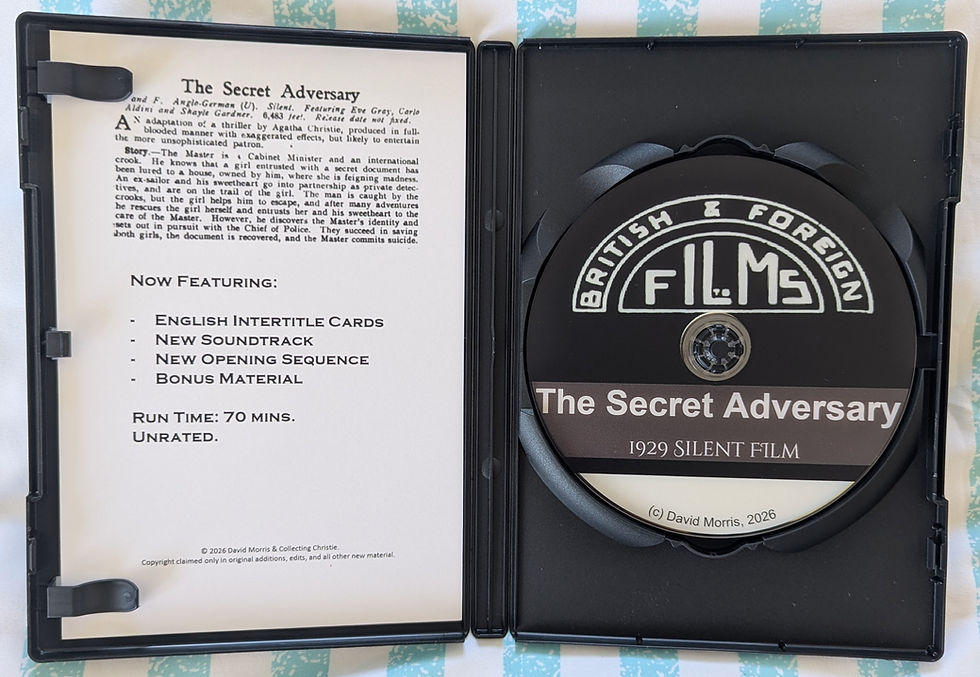
This new Collector’s Edition DVD is ‘region free’ so it can be played anywhere. The format is NTSC, which is the standard format for North America. For those outside North America, if your DVD player is less than 20 years old it should be able to play NTSC even if your default format is PAL. However, do confirm this before purchasing as there are no return options.
Orders:
DVD: Price: $20 US plus shipping (available worldwide*):
1. eBay. I periodically will have a disc for sale on eBay. View my store at: Link.
2. Direct Online Sales: Order direct from the manufacturer: Link.
*: Not For Sale to These Countries: Mexico, Jamaica, Colombia, Equatorial Guinea or Guatemala due to longer-term copyright restrictions than the rest of the world.
Streaming version: An online version is also available for $4.95 US: Link.
Note: Streaming is provided by Kunaki. They assess a $1 per year fee for users of their platform which enables you to stream any acquired content from them for one year.
Closing Comments.
First of all, thank you to friend of the website Hans Kiesl for his insights into the German and Austrian history of the film. He also provided the images from the German press.
As always, if any of the data regarding these films or any of my comments appear inaccurate, do let me know. In addition, any information that fills in the gaps or other updates related to these 1920s films is most welcome. I can be reached at collectchristie@gmail.com
Do consider following me on Facebook, X and Instagram - I can be found on all of those platforms easily under the name 'Collect Christie' or 'Collecting Christie'.
Happy Collecting!


Hello David,
I’m Nicola Malavasi from Malavasi Editore. Would it be possible to receive a complimentary digital copy of Die Abenteurer G.m.b.H.? I’d be very interested in viewing it.
Thank you.
Will you be bringing any copies to Torquay?
John Perry