
Agatha Christie Solves a True Crime!

There are still a number of writings by Agatha Christie that are yet to be published in a book, but have appeared in newspapers and magazines. These are highly collectible and thus are often quite difficult to obtain. ‘Who I Think Did It!’, written by Agatha Christie, is an example of her work yet to appear in a book. This article has only appeared in two magazines – one in Britain and one in the States. Her article relates to a real-life crime committed almost 100 years earlier and provides insight into her own thought processes about crime as she proposes her solution.
Christie & True Crime.
It is well known that true crime informed a number of Agatha’s writings – from The Mousetrap to Murder on the Orient Express. In addition, real crimes were often discussed by characters in her novels. Even when her very first novel was about to be published, we learn from her correspondence that Christie was aware of the appeal of connecting her novels with contemporaneous crimes.
In a letter in 1920 to Mr. Willett, the Director of The Bodley Head, she wrote: I should like the book to come out soon - before Xmas - especially as the Greenwood trial is just coming on. Source: The Christie Archive Trust.
Christie is referencing the 1920 Greenwood trial which was a sensational case in England where Harold Greenwood, a solicitor, was charged with murdering his wife, Mabel, by arsenic poisoning. Since the case shared some similarities with her first novel, The Mysterious Affair at Styles, Christie was clearly savvy in acknowledging that the case may drive interest in her book. But beyond this, it confirms Christie followed true crime cases from her first novel onwards.
The Sunday Times: Great Unsolved Mysteries.
In 1968, The Sunday Times Magazine (England) focused on cold cases in a series of articles under the collective title of Great Unsolved Mysteries (20 October 1968). These cold cases included: the Charles Bravo poisoning case (1876) - a notorious Victorian-era murder in London involving Charles Bravo, whose death by poisoning has never been conclusively solved; The Tichborne claimant case - a famous 19th‑century identity mystery involving a man who claimed to be the long‑lost heir Sir Roger Tichborne; and the Murder in the Glen the unsolved murder of Patricia Curran in Northern Ireland and the wrongful conviction of Scotsman Iain Hay Gordon.
The cover of the magazine featured a photo of Florence Bravo along with a few characters from two of the other stories. The photo selected of Bravo is one that was known at the time of the crime and was considered rather risqué given its significant décolletage.
Recognized authors and journalists were then asked to share their opinions on the cases and provide their own solutions. Agatha Christie wrote about the Bravo case in her essay Who I Think Did It! The article that preceded hers, titled Poison at the Priory and written by Elizabeth Jenkins, discussed the case in great detail providing all the insights one would want without a hypothesis as to who did it. That was left to Agatha Christie.
In The Sunday Times Magazine Christie’s contribution was promoted as "A Letter From Agatha Christie", stating: There have been many theories about the Charles Bravo case. Here Agatha Christie gives the real-life story a surprise twist worthy of Hercule Poirot himself...
The success of this magazine resulted in a book by John Canning, titled Great Unsolved Mysteries. However, it did not include the article by Christie nor the specific case.
Cosmopolitan: Poison at the Priory.
The following year Cosmopolitan magazine (USA) republished Jenkins’s article and Christie’s solution (May 1969), but none of the others that were included in The Sunday Times Magazine.
When Cosmopolitan published the story Florence was not on the cover – instead it was the model Veronica Hamel. She may be familiar to some as after modelling Hamel transitioned to a highly successful acting career, most notably starring as public defender Joyce Davenport in the hit 1980s series Hill Street Blues.
Cosmopolitan promoted the pairing of Jenkins’s article and Christie’s solution as follows:
In this suburban house, nearly a hundred years ago, somebody murdered Charles Bravo. A classic among unsolved mysteries, the case has baffled and challenged experts in detection ever since. The case has challenged and baffled experts ever since. Here, Elizabeth Jenkins describes the background to the crime and outlines one possible solution. On page 175, Agatha Christie gives the real-life story a surprise twist worthy of Hercule Poirot himself…
Poison at the Priory by Elizabeth Jenkins.
The following summarizes Jenkins’s detailed summary of the case:
Florence Campbell was born in 1845. In 1864, she married Alexander Ricardo. Her marriage was plagued by her husband’s infidelity and mental health, which led to her seeking treatment in Malvern by Dr. Gully (aged 62) when she was 25. He encouraged he to legally separate from her husband which she did in 1871. Shortly after, he died and she inherited £40,000. She then began an affair with Dr. Gully which lasted about two years. By the end of 1874, she broke off her relationship with Dr. Gully and soon accepted a marriage proposal from a wealthy Jamaican merchant, Charles Bravo.
Charles Bravo was clearly enamoured by her wealth which now exceeded £60,000 plus property and jewels (approximately £10,000,000 today). However, Florences finances were arranged so that Charles would not secure a portion of this wealth should they divorce or she die. Charles Bravo objected insisting he would not marry her unless he was at least guaranteed ownership of her personal property. She acquiesced and they were married.
Their relationship was turbulent and impacted by several miscarriages as well as ongoing interactions between Florence and Dr. Gully.
One evening in April 1876, Charles became extremely ill claiming he had been poisoned. After three days of extreme pain, he died on 21 April 1876. It was later determined he died of antimony poisoning though how he ingested in was never determined. When the case went to trial the jury concluded he was murdered but that there was not enough evidence to determine the guilty party. The case drew much attention in the press and even led to the exhumation of Florence’s first husband, Captain Ricardo. His body was also found to contain antimony in it though it could not be determined if it caused his death. In addition, he and Florence had been separated for many months prior to his death.
Who I Think Did It! - Solving a Cold Case.
There have been many theories about the Bravo case that have been published over the last hundred plus years but without a doubt Agatha Christie’s decision to pen a solution is the most famous.
Unlike her novels where Christie often does not reveal the murderer until the last few pages, Christie’s opening sentence places the blame directly on Dr. Gully.
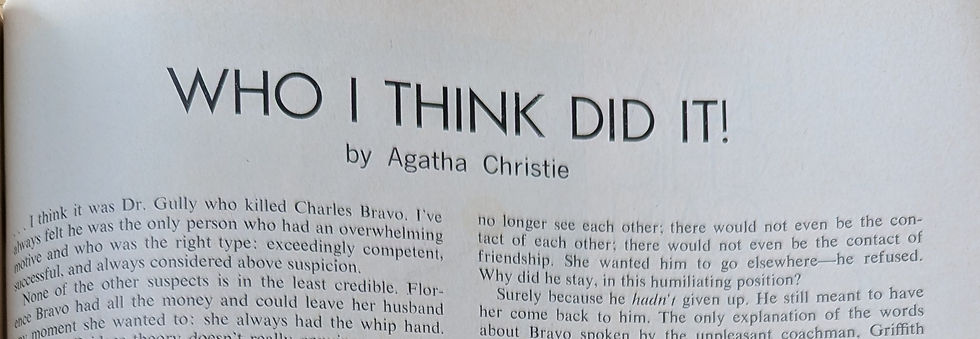
In another part of the article, Christie shares her own memory of her Grandmother talking about a family member who was clearly having a questionable relationship!

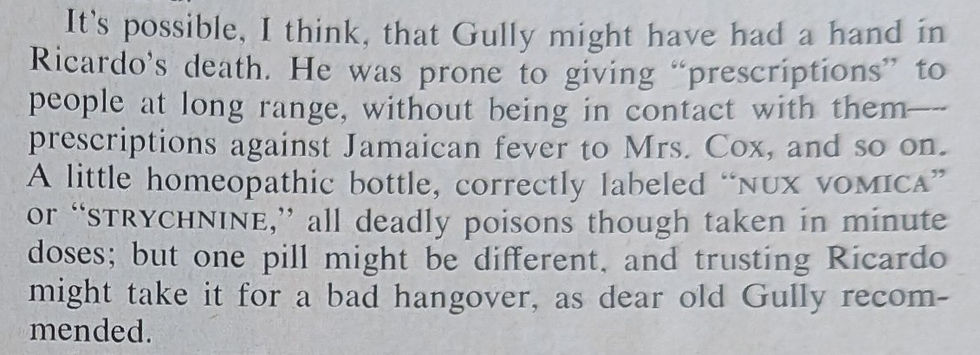
For fans of Christie’s works though, the article is of great interest as it provides insights into how Christie sees relationships and crimes of passion, as well as how crime could be committed.
Value & Scarcity.
For fans of Christie, either of these magazines is well worth seeking out. However, both are surprisingly challenging to find. While most copies of The Sunday Times Magazine from the 1960s will sell for £15 - £25, this particular issue (October 20, 1968) is fairly valued at £40 - £60 because of its content. Cosmopolitan magazines from this era routinely sell for $15 - $25, but because the May issue contains original Christie content, expect to pay $60 - $80. While the prices are still affordable, finding one will be your biggest challenge. Patience and regular checking of online sites will be your best course of action.
Other Items:
A few tickets still remain for my talk at the International Agatha Christie Festival in Torquay this September. I'll be sharing fresh insights into Christie's masterpiece - The Murder of Roger Ackroyd. Details at https://www.tickettailor.com/events/agathachristiefestival/2100162
Later this year, I'll be sharing some news about a wonderful book I was able to contribute to along with some other projects that I'm excited about. So do consider following me on Facebook, X and Instagram - I can be found on all of those platforms easily under the name 'Collect Christie' or 'Collecting Christie'.
Last, but not least, I can be reached at collectchristie@gmail.com - I enjoy hearing from you so don't be shy if there's something you want to share, a correction or edit to any of my articles or something you'd like to read about.
Happy Collecting!


Stories like this alway set me to wondering about the murderer who 'got away with it'. Did they live out their lives in acceptance of what they'd done, or were they haunted by it like some character from Edgar Allan Poe?
Regardless, this is a fascinating article. Thanks!