
Agatha Christie's Uncollected 'Tit-Bits' Article

There have been many magazines and newspaper publications that have printed fictional and non-fictional works of Agatha Christie over the last hundred years. While most of these published stories later appeared in book form or in short-story collections, a few published articles by Christie remain 'uncollected' - thus not yet gathered or included in any form of book. These Christie stories or articles can still only be read by sourcing that original magazine.
Tit-Bits.
One of these uncollected articles appeared in Tit-Bits, a British magazine launched in 1881 by George Newnes. The publication’s original vision was to provide ‘Tit-Bits from all the interesting Books, Periodicals, and Newspapers of the World.’ This concept is similar to modern publications such as The Week.

Tit-Bits evolved over the decades and by the 1930s it had become one of the earliest publications trended towards tabloid journalism. It specialised in 'human interest' snippets with short stories and full-length serials by authors such as Rider Haggard. In its first few decades, text dominated its pages while advertising was on the covers. However, by the 1930s onwards photography became more integral to the publication.
After World War II, it was one of the first magazine to use regular pin-ups on its covers and these dominated from 1950 onwards, fully pushing the publication towards tabloid status. This was also the decade when its circulation peaked with over one million copies of each issue frequently published. Imitators popped up around the world, including Tid-Bits in the USA.
The magazine ended in 1984, when its assets were acquired by Associated Newspapers' Weekend. The new ownership vowed the name, logo and publication would never exist again to avoid those assets being repurposed by adult-content publishers.
Christie’s Tit-Bits Appearances.
Agatha Christie appeared in Tit-Bits three times across a 37 year span. Two appearances were short stories, while the third was a fascinating piece of non-fiction. It is this latter piece that remains uncollected and the focus of this article.
1929: December 14. Issue No. 2511. Alibi. Originally published as The Unbreakable Alibi in the December 1928 Christmas magazine Holly Leaves. This Tommy & Tuppence short story was included in Partners in Crime, published in 1929. As the image below shows, Christie's name was highlighted on the top of the cover of this issue, along with Edgar Wallace.

A copy of this publication sold in the November 2024 Forum Auction sale of John Cooper’s Collection (image above). Lot 108 realised a hammer price of £120 ($150) benchmarking it’s likely value today.
1930: September 27. Murder and our Sporting Instinct. This article is accompanied by the magazine’s heading of Famous Detective Writer’s Theory. It remains uncollected in any other book or magazine. More on this below!

1966: Summer Special. The Golden Ball. This short story was originally published on August 5, 1929, in The Daily Mail. It was included in The Listerdale Mystery, published by Collins Mystery in 1934. It seems rather an odd choice to acquire the publication rights to this 37 years after it first appeared given all the other stories they could have sought. This story did not appear in the US in any form until it was included in the 1971 book The Golden Ball and Other Stories, published by Dodd, Mead & Co.
The other articles that accompanied Christie's story hardly sound like literature - Snapping the World's Top Beauties' and 'How to Succeed on the Beach without Really Trying'. Arguably the more unique magazine publication to include a Christie short.
Murder and Our Sporting Interest.
Of these issues, the 1930 issue is of greatest interest for fans of Agatha Christie not solely because it remains uncollected, but because of its content. Within Christie’s article, she shares with us her opinions on what makes crime interesting to readers, reaffirms her awareness of true crime cases, discusses how to effectively construct a crime novel, and charmingly reveals her sense of humour.
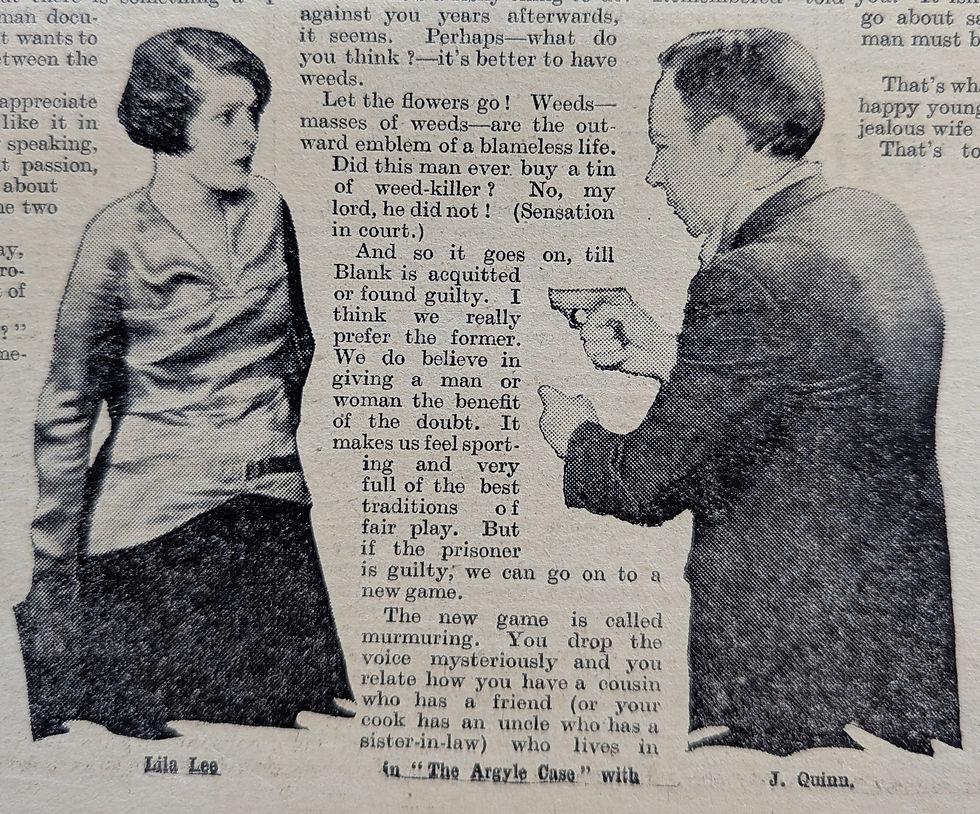
For example, the article discusses how one person told Christie that crimes passionnel are not very interesting to newspaper readers because there’s nothing to solve – it’s clear who did it. Christie then says:
And there you have the secret to our British attitude to crime. It has got to have a sporting element.
Christie observes that crimes where the criminal is yet undiscovered are far more interesting to follow in the press. Christie comments that:
The crime passionnel can never be, in the literary sense, crime. [It] must be embodied in the novel of human interest for the crime itself is only a detached incident in the story.
She continues with her thoughts on what does interest readers:
And so comes about the curious anomaly that our “light reading” is usually concerned with the most serious of subjects – Death.
When discussing clues discussed in real life crime cases, she writes with humour:
The evidence is very thin, and after all we’ve all bought weed killer in our time – in fact, I ordered some myself yesterday. I wonder if it was wise? … They do seem to attach a lot of importance to these purchases. It’s a risky thing to do.
But it is her comments about how to structure a novel that I find most interesting as these comments resonate throughout her works. Christie writes:
It is in what went before that the interest lies. It may be a sordid story, revolting in its details. It may be beautiful. It may be highly interesting, full of intricate psychology. It may have the stark simplicity of pure primitive passion. It may have the detached remoteness of an idyll.
The article is accompanied by two stills from films. The first is of Lila Lee and J. Quinn who starred in 1929 film The Argyle Case and a scene from the 1914 film, Typhoon. Both involve crimes of passion that are not easily solved.

For those interested in the craft of Christie, the article is a must-read and thus worth seeking out. Hopefully one day it will be included in a new publication so it is easy to find. For now, while it is out of copyright in the USA, it is still under copyright in the UK. Obtaining a vintage magazine is very challenging but a patient and diligent collector will ultimately obtain one. Other sources include the archives of the British Library and potential could be in the archives of your local library.

Britannia & Eve.
In February 1930, half a year earlier, an article by Christie titled 'The Crime Passionelle' was published in Britannia & Eve. I have yet to locate a copy of this article, but I expect the content is similar given the overlap of its title and the content of this Tit-Bits article. If anyone can share an image or provide insights, please do.
Value: Given the recent auction sale price of the 1929 Tit-Bits issue of £120 ($150), I would expect this 1930 issue to be fairly priced at £200 ($260) given its more unique and uncollected content. That said, it is likely possible to find one at a far lower price if the vendor is less familiar with its contents.


I encourage curious readers to go to my blog and explore this detailed post. The author combines useful information with realistic examples. The subject is presented patiently from the beginning. I liked the discussion of different possible approaches. The conclusion offered sensible guidance. This website is worth following.
Anyone who decides to read our blog can benefit from clear explanations and thoughtful examples. This article introduced the subject gradually. The author remained focused on relevant details. I especially valued the discussion of practical consequences. The conclusion was concise and balanced. This was an excellent post.
The professional insights shared here helped me understand the subject from a new perspective. The author explores both common practices and less obvious details. I appreciated the calm and objective tone. The examples made the information easier to apply. The conclusion brought the discussion together naturally. I will gladly read more articles.
The industry knowledge in this post is presented in an accessible and organized form. The author explains how different factors influence the final outcome. I appreciated the practical examples and realistic conclusions. The article remained focused without oversimplifying the subject. The final paragraph encouraged further research. This was a very valuable read.
This was the kind of piece I'll probably reference again the next time this topic comes up. The explanations were clear enough to stick without needing to reread the whole article later. That retention value is a good sign of genuinely useful knowledge rather than a forgettable overview. Thanks for such a memorable and well-explained piece.