
The Seven-Penny Agatha Christies.

Updated: Aug 10
In the late Victorian and Edwardian periods, publishers were steadily lowering the cost of fiction in a variety of ways. One cost cutting approach was the discontinuation of the three-volume novel and the move to a single volume per title. Cheaper reprints with less expensive bindings and paper also started to proliferate. To gain market share, publishers started to compete aggressively on price. In the 1910s, just before the Great War, publishers including William Collins & Sons, Co., Ward, Lock & Co., and Hodder & Stoughton started issuing many titles in a "Sevenpenny" (7d) series that was priced to attract a broad range of ordinary readers.
Ward, Lock & Co.’s series ran from 1912–1917 and included adventure, detective, and popular fiction by writers such as Conan Doyle, Edgar Wallace, and E. Phillips Oppenheim. One of their most collectible ‘Sevenpenny’ printings is the 1912 edition of Arthur Conan Doyle’s A Study in Scarlet, which was number 7 in their series. Hodder & Stoughton’s ‘Sevenpenny’ series included writers such as H. Rider Haggard, but appears to have only last a few years – from about 1913 to 1914.
While most of the seven penny novels pre-war were hardback, a number of them after the war were paperback. One such publisher was Newnes, publisher of The Strand magazine, who had the rights to many Sherlock Holmes stories. Several of these were published in a Sevenpenny paperback after the war.
The affordability of the seven-penny books for the general public made the price point a defacto brand. However, the seven-penny novel slowly disappeared due to inflation and the growth of the even cheaper six-penny alternative.
Collins & Christie.
When Collins started selling Agatha Christie novels from 1926 onwards, the first editions were priced 7s & 6d (7/6). There were 12d (pennies) in 1s (shilling), so a 7/6 novel was essentially 90d – so over twelve times more expensive that a seven-penny edition. While Collins reduced the prices on their reprints to 3/6, and then to 2/- and even 1/-, those were all still over the price many readers had enjoyed paying for hardbacks before the war.

To extend the life of the market for Christie hardbacks, Collins announced in early 1934 that they were bringing back a ‘Sevenpenny’ series of hardbacks. Collins stated their intention to recall the nostalgia of those popular pre-war novels.
They even planned on producing them in a similar size and quality to the earlier books published by themselves, Ward, Lock & Co. and Hodder & Stoughton. Collins stated that the price had been chosen to exclude the books from "six-penny chain stores", making them suitable for mainstream booksellers. The advertisement below shows how Collins promoted these different price points to booksellers.
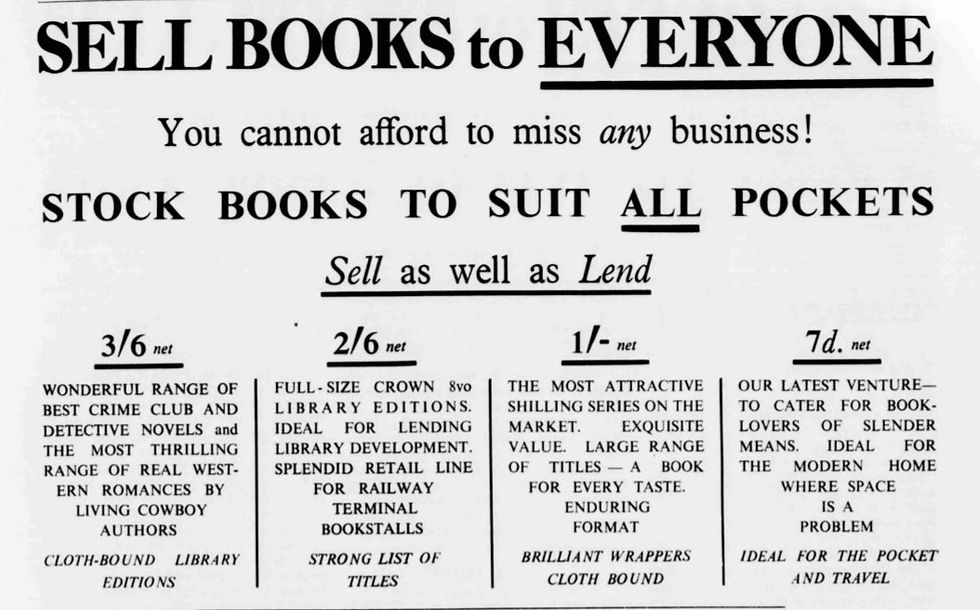
In the UK in the 1920s "six-penny chain stores" were stores based on the Woolworth model which involved selling many everyday items at two fixed low price points which were usually 3d (three pence) and 6d (six pence). These were similar to the 99p and dollar stores of today. Collins’s decision to use 7d as the price point was specifically designed to help drive traffic to booksellers – a strategy that was warmly received. In fact, prepublication interest clearly drove a faster release than planned.

The Collins Seven-Penny Series.
The first books in the series were mostly crime and thrillers, including The Steward by Edgar Wallace, The Crime Conductor by Freeman Wills Crofts, and The Motor Rally Mystery by John Rhode. Agatha Christie first title in this series was Peril at End House. These were not paperbacks, but hardbacks with dust-jackets. However, they were smaller than Collins’s other hardcovers and measured 6¼ inches by 4 inches. When one considers that the new paperbacks of Christie titles by John Lane and Collins were selling for 9d (nine pennies), these hardbacks were of exceptionally good value.
The series was launched with twelve initial titles, including the aforementioned Agatha Christie – The Peril at End House. While all these books show a copyright date of April 1934, their launch date was actually May 2, 1934.
In October 1934, three new titles were added to the catalogue of seven-penny novels, one of which was The Murder of Roger Ackroyd.
Additional titles were periodically added. The Murder at the Vicarage was published in June 1935, and the last Christie in this series, The Sittaford Mystery, appeared in March 1936.
It probably didn’t take an economist to realise that this business model would not be sustainable and that ultimately paperbacks, which cost far less to produce, would be the future of cheap books. An article even appeared shortly after their announcements questioning how long the "Sevenpenny" would last. Collins’s new Sevenpenny series only lasted for three years.

In summary, the four Agatha Christie titles in this format were as follows:
1934 Apr Peril at End House
1934 Oct The Murder of Roger Ackroyd
1935 Jun The Murder at the Vicarage
1936 Mar The Sittaford Mystery
Collectability & Values.
These titles are surprisingly difficult to find in a very good jacket but are quite affordable when found. I have no doubt prices will rise with the awareness this article brings to them, but as unique collectibles with an historical back-story, I think a very good copy in like jacket is fairly valued at £100-150 ($130-200). Since supply is scarce, you’ll probably need to pay what you can afford if this series appeals to you to collect.
Note: All the data regarding printings, editions and dates is to the best of my knowledge. Any information that fills in the gaps or other updates from our readers is most welcome.
The Collecting Christie Shop!
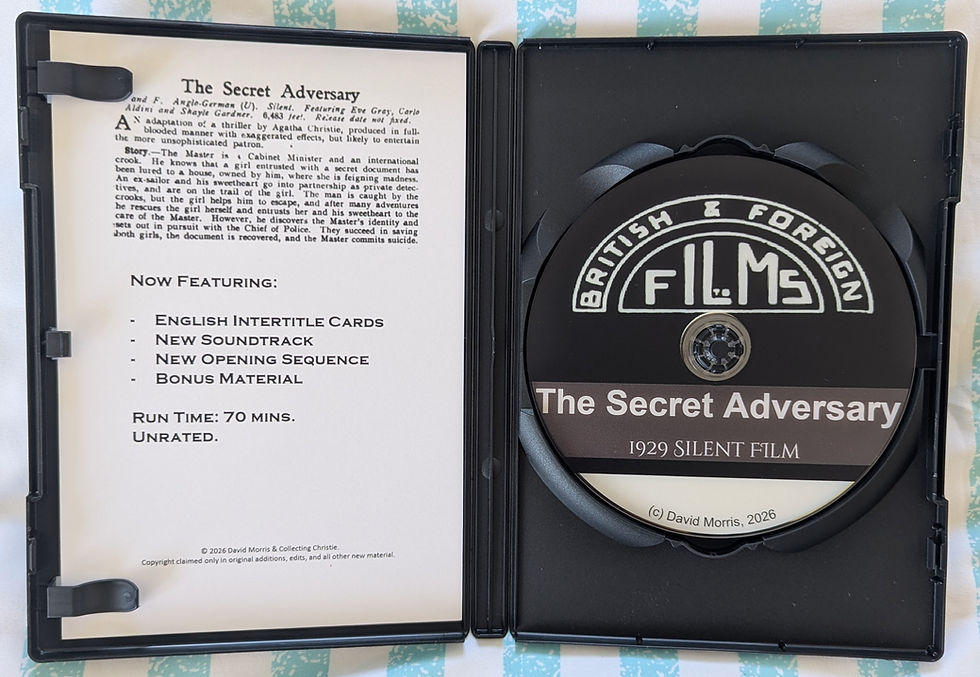
My online shop provides you with details on the recently produced new "Collector's Edition" of the oldest known Agatha Christie film adaptation - The Secret Adversary (1929). Now with a complete English translation for the first time ever, along with a dynamic classical music score, plus bonus material after the film.
Also in the 'shop' is a link to my eBay store where I will periodically list excess stock from my personal library, including Agatha Christie, other Golden-age authors and newer mystery fiction.
Shop Link: Click Here or go to the top of the screen and click 'Shop'. All purchases are greatly appreciated as it helps support the costs of maintaining the website.
I have a few other projects in the works too!
New Book! - Agatha Christie: A World of Mystery.
I am also pleased to share that I contributed two essays to the upcoming book 'Agatha Christie: A World of Mystery' to accompany the British Library exhibit opening later this year. Preorders are now available on Amazon at: Link.
Closing Thoughts.
Lastly, I look forward to seeing many of you in Torquay next month at the International Agatha Christie Festival.
Do consider following me on Facebook, X and Instagram - I can be found on all of those platforms easily under the name 'Collect Christie' or 'Collecting Christie'.
Last, but not least, I can be reached at collectchristie@gmail.com - I enjoy hearing from you so don't be shy if there's something you want to share, a correction or edit to any of my articles or something you'd like to read about.
Happy Collecting!


While having no great shakes with computers, have slightly 'improved' your Sittaford image?
Most enjoyable - many thanks!